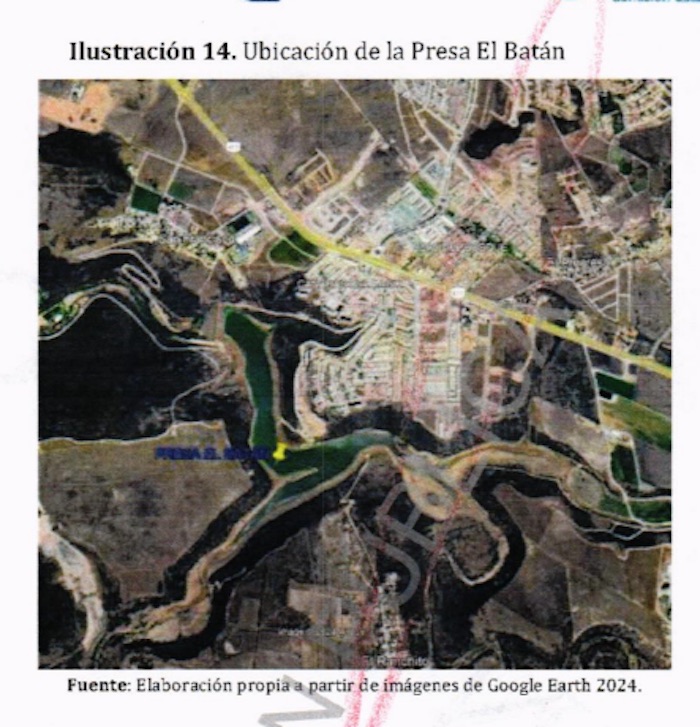
Querétaro Governor Mauricio Kuri sent a bill to the state Congress authorizing the State Water Commission to develop the “Batán System” project, with a public-private investment of up to 35 billion pesos. This project has raised concerns about potential risks to public health, as NOM-27-SSA-2021 states that water for human consumption should not be treated.
The legislative initiative contemplates, over the next 30 years, the rehabilitation and construction of plants to treat wastewater from the Batán Dam—contaminated by urban discharges—and make it potable to supply only the metropolitan area of Querétaro, Corregidora, and El Marqués, without considering the communities in the mountains and semi-desert where water rationing occurs for weeks at a time.
“What concerns us most is the health issue. The project contemplates treated drainage water for human consumption. They mention that the project adheres to (outdated) Mexican health and water treatment standards. It’s drainage water that comes from homes, hospitals, factories, and slaughterhouses, and the Governor says he’ll treat it (for domestic use). The treated water is for agricultural or industrial use,” said Javier Bravo.
Investment in the Batán project
The initiative sent by Governor Mauricio Kuri to the Querétaro Congress requests, in point 35, the authorization of up to 35 billion pesos for the Batán project. Image: Querétaro Congress.
With an authorized amount of 35.722 billion pesos for operation and maintenance, with an initial investment of 9.59 billion pesos, the system includes three treatment plants: expanding the South (800 liters per second) and the San Pedro Mártir (1,000 liters per second), and building one in Corregidora (60 liters per second); as well as building a water treatment plant with a capacity of 1,800 liters per second, the initiative proposes.
“We are not opposed to the construction of this Batán project and the lack of treatment of the drainage water. It should be done, but not at that cost and not for human consumption. This treated water should be delivered to companies like Amazon’s data centers, which require a large amount of water for their chillers; not to be given well water to be wasted cooling their equipment,” Javier asserted.
Federal Representative Gilberto Herrera has called it a “Querétaro Fobaproa” for water, but Governor Mauricio Kuri has recently stated that “the most expensive thing is to run out of water.” The governor assured that he is open to holding the public hearing requested by more than 600 citizens to provide detailed information about the Batán project, but asked the local Congress to approve it by 2025.
“It has been handled very politically and many people have been misinformed. I think it is important for people to be fully aware of the project. Of course, my recommendation would be for it to be approved this year, but it is in the hands of the Legislature, and I am very respectful,” Kuri expressed.
Health Risk
Among the main public concerns about this public-private project—which would put Querétaro in debt for three decades—are whether the treated water will be free of endocrine disruptors; who will be responsible for the potential impacts on the population’s health; Or, why will that treated water be used for domestic purposes instead of agricultural or industrial purposes, as is typically the case with treated water?
“The problem is so-called emerging contaminants such as pharmaceuticals, pesticides, industrial chemicals, microplastics, and endocrine disruptors that will greatly affect health. They alter your entire hormonal system, and you can have thyroid problems. And Querétaro is not part of the IMSS-Bienestar system. Our public health system is hanging on by threads, and there is no efficient system in the world that can eliminate them (from wastewater),” Javier explained.
The initiative was sent by PAN Governor Mauricio Kuri to local representatives on June 3, requesting its approval by 2025. Kuri’s administration held a rapid citizen consultation between May 14 and 21, in which 15,392 citizens participated without publishing technical studies on risks and oversight mechanisms for treated water quality.
17 votes are required for approval by the Querétaro Congress. His party, the PAN, does not have a majority, but he has legislators from the PAN, PRI, Movimiento Ciudadano, and even the Green Party who could approve the Batán project.
“In the 2024 elections, citizens wrested control of Congress from the PAN, but they currently control it because they have more representatives, as the two Green Party representatives (Perla Flores and Georgina Guzmán) betrayed the movement and defected to the PAN. The PAN is missing four votes that must necessarily come from the Morena bloc, where there is already an independent representative (Enrique Correa) and a representative from the Labor Party (Claudia Díaz Gayou). There are Morena representatives who have already voted for the PAN, such as Sinuhé Piedragil, Homero Barrera, Sully Mauricio Sixtos, and the independent Ulises Gómez,” explained Javier.
Water privatization?
By proposing a public-private investment, civil society organizations are questioning Mauricio Kuri’s government on how it will prevent the private sector from influencing rates, distribution, and usage priorities, as has been seen in states like Puebla and Quintana Roo.
“There hasn’t been made accessible—that is, public, timely, and in citizen-friendly language—information that makes it understandable why the El Batán System project would be a risk-free solution and a more suitable alternative than others,” states a statement published by various local organizations such as the “Fray Jacobo Daciano” Human Rights Center, the Querétaro River Basin Commission, the Citizens’ Network for EcoRestoration, among others.
A few days ago, Governor Kuri, who is now mentioning an initial investment updated to 11 billion pesos (2025 price), told the press: “I would also like the investment to come entirely from the government, but if there’s no money… The federal government provided 50 percent for Aqueduct II, and thanks to a mixed investment, we won’t run out of water. I think the most expensive thing is running out of water.”
The Collective Spokespeople for Mother Earth presented a request to the board of directors of the Querétaro Congress to convene an open parliament and also filed a lawsuit seeking indirect amparo for lack of public consultation in accordance with the standards of the Escazú Agreement, to which Mexico belongs.
With the signatures of more than 600 citizens, on July 7, the organizations also requested the State Environmental Council hold the first public hearing to raise questions and make proposals about the Batán System project. Luis Alberto Vega Ricoy, Executive Member of the Querétaro State Water Commission (CEA), will meet with these petitioners.
Among the citizen proposals is a monitoring mechanism to ensure the safe and environmentally friendly operation of the treatment plants and a review of the project’s financial viability.
They also point out that the water crisis in Querétaro must also address watershed regeneration, rainwater harvesting, modernizing pipelines to reduce leaks, and resorting to water sharing. This means providing treated water to the agricultural and industrial sectors, and ensuring that both sectors provide their licensed wells with clean groundwater for domestic use.
Source: sinembargo