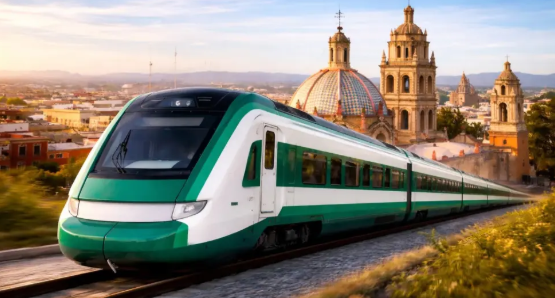

As part of the construction of the Mexico City-Querétaro passenger train, the expansion of the railway underpass beneath Bernardo Quintana Boulevard, one of the main thoroughfares of the state capital, will begin on Monday, July 13.
This work will last seven weeks—from July 13 to August 30—with crews working 24 hours a day, seven days a week, explained Colonel Engineer Rodolfo Paz Sánchez.
The resident engineer for section 12 of the railway project explained that the train’s construction—being carried out by the Felipe Ángeles Engineering Group—will consist of 232 kilometers of track and is comprised of 12 work fronts, four of which (sections 9 through 12) are located in Querétaro.
Currently, two freight lines run along the railway line. This phase of the project involves establishing a new freight line to the north and a new passenger line to the south.
“To the north, there will be two freight lines. Currently, there are two freight tracks; one of them will be converted to passenger service, and we will build a new passenger line. The infrastructure for a new freight line will also be constructed, so that we will have two freight lines to the north and two passenger lines to the south,” he explained.
The project will maintain the same clearance height (maximum dimensions for a vehicle to pass over the tracks) of 4.5 meters. The work will be carried out simultaneously on both sides of the track, and it is expected that the train will continue running during the construction process, he explained at a press conference, where federal, state, and municipal authorities announced the works that will impact the railway bridge that crosses the boulevard.
Local authorities acknowledged that, being a high-traffic artery, there will be significant disruptions to mobility in the Metropolitan Area; therefore, they will deploy an operation to mitigate the impact.
Starting Saturday, July 11, the traffic strategy will begin, representing a deployment five times larger than the one previously implemented on Corregidora Avenue when the federal project affected that road, explained Gerardo Cuanalo Santos, director of the Querétaro State Mobility Agency (AMEQ).
150,000 vehicles travel along Bernardo Quintana Avenue daily, while 30,000 vehicles travel along Corregidora Avenue. The operation will be divided into two phases: the first in July and the second in August. Both phases include lane closures and contraflow lanes.
Due to the project’s scale, the operations will be coordinated with three metropolitan municipalities: Corregidora, El Marqués, and Querétaro.
Four strategies will be implemented: 25 traffic lights will be set to flashing mode, 166 traffic assistants will be deployed, 160 points will be marked to facilitate detours, and traffic control devices will be installed.
The four public transportation routes that pass through the area (T02, T13, C57, and C63) will not be affected; they comprise 55 buses and serve 30,000 passengers.
During the seven weeks, the municipal and state governments will implement remote work; this is expected to remove 2,000 vehicles from the roads, highlighted the mayor of Querétaro, Felipe Fernando Macías Olvera. He also urged neighboring businesses and companies to replicate the measure.
“Very complicated weeks are coming in terms of mobility for the entire Metropolitan Area. While the greatest impact will be on the neighborhoods directly affected by Bernardo Quintana Avenue, the impact, the complications, will be felt throughout the city of Querétaro and also for the Metropolitan Area,” he stated.
With this plan, they expect to work through the vacation period and finish before the return to classes, stated the state’s Secretary of Government, Erick Gudiño Torres.
According to the federal government, as of the end of June, the Mexico City-Querétaro train project was nearly 20 percent complete.
Source: eleconomista