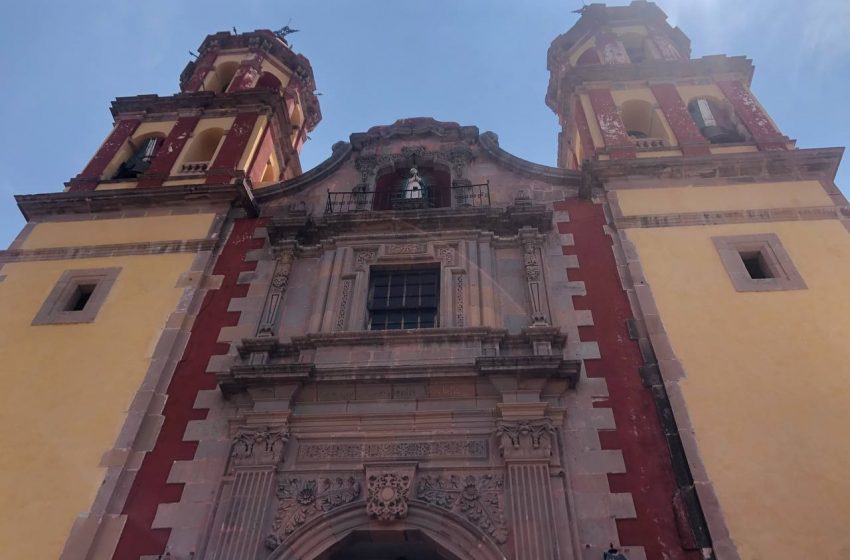
The municipality of Querétaro boasts one of the most extensive religious heritages in the country, with approximately 277 Catholic churches distributed across its seven districts. Of these, 20 temples, convents, and monasteries are located in the Historic Center, recognized by UNESCO for its Baroque architecture and cultural significance.
This year, religious tourism took center stage thanks to the Jubilee Year, a celebration based on Catholic doctrine, biblical tradition, and a deeply rooted symbolic myth. Its origin lies in the Book of Leviticus, where every 50 years a time of liberation was proclaimed with the sound of the shofar, a horn that marked the beginning of a period in which—according to tradition—”everything returned to its original owner”: debts were forgiven, slaves were freed, and social order was restored. This narrative element, half tradition and half symbol, is considered the “founding myth” of the Jubilee: a complete reset and a return to harmony.
The Church revived this concept in 1300 and transformed it into a time of spiritual grace, centered on conversion, penance, and plenary indulgence. Since then, it has been celebrated every 25 years and attracts millions of faithful worldwide.
In Querétaro, where 81% of the municipality’s population identifies as Catholic, the Jubilee tradition has significantly boosted tourism and participation in religious activities.
“We have received around 73,000 visitors”: Mariana Ortiz
The Secretary of Tourism for the capital city, Mariana Ortiz, celebrated the success of the religious route created specifically to coincide with the Jubilee Year.
“We launched this religious route during the Jubilee Year, in coordination with the diocese… We estimate that approximately 73,000 people have visited it,” she explained.
“The relics that have received the most visitors are those of Carlo Acutis, of course John Paul II—who came accompanied by Mother Teresa—and several other saints,” he noted. He also emphasized the importance of promoting permanent relics such as that of Saint Jude Thaddeus in Juriquilla, one of the areas with the greatest popular devotion.
“We formed an alliance with San Juan del Río so that the relics wouldn’t just stay here… there are also many parishioners who went to visit them there,” he indicated.
Along the same lines, he suggested that this model could be replicated in other municipalities in the metropolitan area: Corregidora, El Marqués, and Huimilpan.
“We would also love to start this conversation; we believe it could work very well,” he commented, pointing out that Querétaro is part of the International Network of Religious Tourism, which facilitates attracting specialized tour operators.
According to Ortiz, December will further boost the route:
“We are estimating approximately ten thousand more people to conclude our year,” she stated.
The official maintained that, due to its success, the municipality will seek to maintain the religious strategy throughout 2026 and expand partnerships with more municipalities and even with the Sierra Gorda region, where there is also a significant heritage of mission churches.
The intersection of biblical tradition, spiritual symbolism—including the myth of the Jubilee as a “reboot” and restoration—sacred architecture, and a tourism strategy coordinated with the diocese has solidified Querétaro as one of the most dynamic religious destinations in the country by 2025.
Source: codiceinformativo