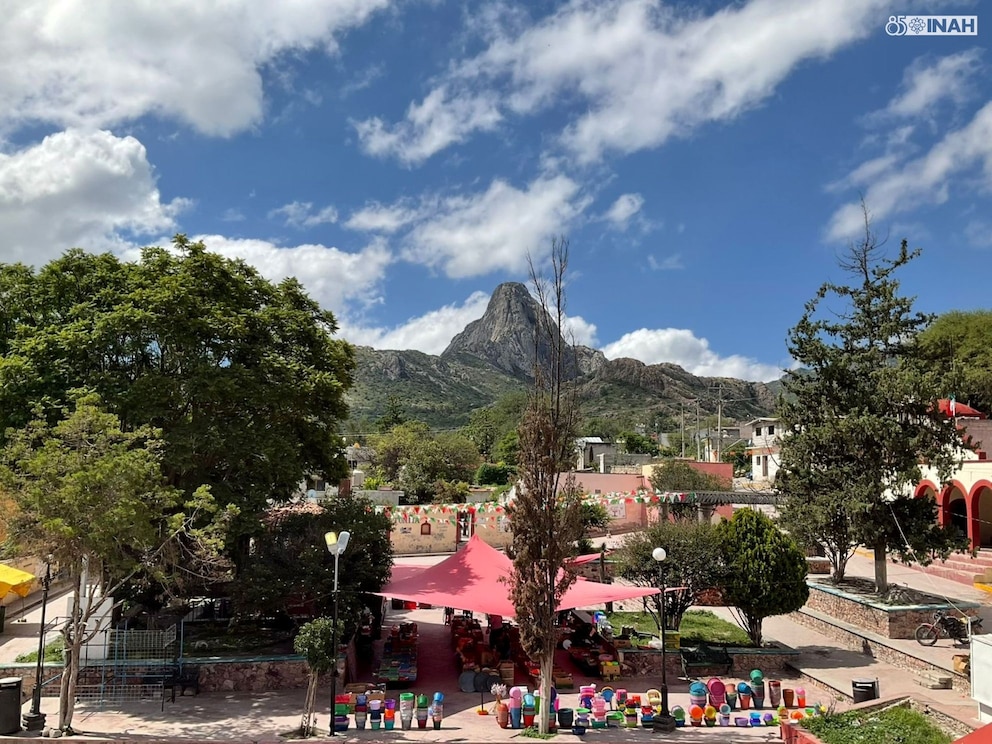
Photography gives us the opportunity to learn more about the world around us, whether capturing architectural structures, animals, landscapes or people who become protagonists, bringing us closer to an episode imbued with aesthetic sense.
In the midst of insipidity, the image of a corner of Mexico can serve as entertainment, to relieve the eyes and to discover a new detail that could be used to show off in meetings.
This photograph invites us to reflect on the greatness of human creativity and the beauty of what is found in the country. Without further ado, below is the image of the day, provided by the National Institute of Anthropology and History (INAH).
The Querétaro semi-desert represents the region with the greatest aridity in the state, extending towards Guanajuato. Its climate is predominantly arid and is crossed by a strip that crosses the state from side to side.
This area is the gateway to the Sierra Gorda, offering a diverse natural environment that combines forests and arid zones. In addition, the semi-desert is home to important historical remains, such as ancient walls and Otomi family chapels, which reflect the rich history and tradition of the region. This entire area can be accessed on tourist routes promoted by the INAH.
The wealth of Mexico captured in images
The country is full of diverse landscapes and cultures that enrich it. From pre-Hispanic peoples to the present day, it has a varied heritage throughout the territory, which is the fourteenth largest in the world. Although in Mexico the main language is Spanish, there are 67 indigenous languages that coexist daily.
Deserts, beaches and jungles are some of the diverse ecosystems of Mexico, which together with the cities, make it possible for each photograph of the day to be different from the previous one, without leaving aside its didactic factor.
According to the federal government, there are 189 archaeological sites. Among the most representative are Teotihuacan, Tajin, Palenque, Tulum and Chichen Itza, the latter considered one of the 7 wonders of the world since 2007 and a world heritage site, declared by the United Nations Educational, Scientific and Cultural Organization (UNESCO) in 1988.
Among other spaces registered as world heritage sites, there are six natural sites, as well as the ancient Mayan city of Calakmul, located in the state of Campeche. Throughout the 31 states there are 120 thousand historical monuments, 1,321 museums, 1,976 cultural centers and 111 magical towns.
In the images selected by the INAH, you can see pre-Hispanic pieces, landscapes, murals, ruins, nature, and even corners of the different cities that run from north to south.
Source: infobae