
The 2026 FIFA World Cup has not only brought together thousands of fans arriving from Japan. It has also highlighted a community that, although it originated more than 11,000 kilometers away, is now part of everyday life in Mexico.
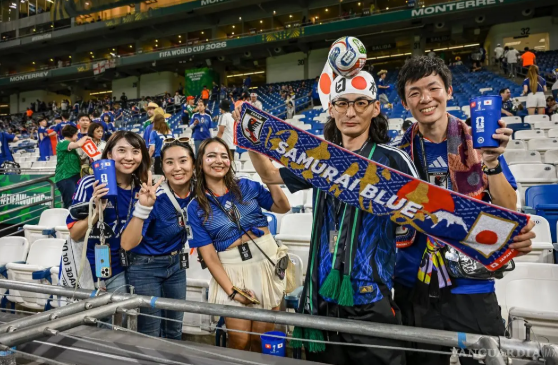
Near the stadium where Japan played its 1,000th match in World Cup history, several Japanese supporters revealed that they no longer live in Asia. Their home is now in states such as Guanajuato, Querétaro, and other regions of Mexico’s Bajío area, where the Japanese presence has grown over recent decades due to the automotive and manufacturing industries.
For them, the World Cup has a special meaning. They are not only supporting Japan, but also celebrating Mexico as host of the world’s biggest football event.
“We live in Mexico now,” commented one of the interviewed fans, originally from Japan but established in Guanajuato for some time.
Their story is not unique. A few meters away, another supporter explained that he has lived in Querétaro for approximately a year and has already begun adopting customs, expressions, and habits from Mexican culture.
Signs of adaptation appear in details that may seem small but reflect everyday integration. During conversations, several Spanish words emerged as part of their regular vocabulary, ranging from basic expressions such as “thank you” and “I don’t know” to more colloquial phrases learned through daily interactions.
But if there is one thing that has truly won over many Japanese residents in Mexico, it is the food.
“I really like tacos,” one of them admitted without hesitation.
Another fan went further while speaking about the city where he currently lives.
“Guanajuato is a very beautiful city, and the food is also excellent,” he explained while proudly wearing the colors of the Japanese national team.
Food became one of the most common topics among the supporters. Some mentioned tacos as their favorite dish, while others said they had tried different regional specialties during their time in the country.
Football has also served as a cultural bridge. Several of them closely follow the Mexican National Team, know Mexican football players, and stay informed about what is happening in Mexican football.
The relationship between Mexico and Japan has found a perfect showcase in the World Cup. While thousands of tourists arrived to support the Samurai Blue for a few weeks, other Japanese people are already part of Mexican communities and experience the tournament from a different perspective.
They are not occasional visitors. They work, consume local goods and services, speak Spanish, and have built lives in Mexico.
That is why, when Japan takes the field, they celebrate like any Japanese supporter. But when they walk through the streets of Monterrey, Guanajuato, or Querétaro, they also do so as people who have found a second home in Mexico.
Source: vanguardia